Rules For AI in Creative Work
Previously Published in Entre Nous Magazine
I saw the writing on the wall:
In a very short amount of time, AI was going to annihilate major parts of my career, an industry, and an art form I hold dear:
Photography.
AI image-making has gone from amusing to reality-defying. Stock photography, product photography, and huge portions of commercial portraiture have already been bulldozed by the ability to type a few sentences and conjure an image out of the ether.
A couple of years ago, someone turned me on to AI-generated images.
As a photographer, I was tempted to feel threatened by it.
That would have been reasonable. Some categories are never coming back. The horse has not only left the barn, it has generated twelve photorealistic barns in different lighting conditions, started a Patreon, and an OnlyFans with AI generated horses.
Then I tried it. (AI, not the horse’s OnlyFans)
With a few sentences, AI created images that felt like an uncanny translation of the pictures I held in my head.
That led to a very strange realization:
It was just as fulfilling, maybe even more so, to generate images with AI than to make them with an actual camera.
I did not see that coming.
I realized I am far more interested in being a storyteller than I am in being a photographer. I will always be a photographer. It is a gorgeous art form. It shaped my eye, my instincts, my taste, my relationship with light and life.
It’s just that I love storytelling even more.
I’ve always tried to make storytelling images in my photo career. In my Progressive House work, I’m a storyteller. In writing, obviously, I’m a storyteller. The tools keep changing – the obsession stays the same.
My relationship with AI is currently very love / hate.
How’s yours going?
As a creative professional, both at my day job and in my personal work like *Entre Nous*, I’m under constant pressure to create better, faster, and cheaper.
A year ago, the vibe was:
“Oooh, look what AI can do.”
Now the vibe is:
“Eeeew, look what AI is doing.”
Both reactions are valid.
AI can feel miraculous. It can also feel cheap, creepy, soulless, and manipulative, and all before lunch.
Still, there is a strong case for using it.
The question is not whether AI is good or bad. That’s too blunt of an instrument. The better question is:
When is AI kosher?
What makes it kosher?
I’ve racked my brain over this. What are the sensibilities of the marketplace? What is public sentiment? What are my own instincts? What grosses me out?
What feels okay when I see others use it?
I’ve boiled it down to four principles.
These will probably change over time, because the technology will change, the culture around it will change, and so will I.
As of June 2026, these are the principles I hold myself to when I use AI to create.
1. Tell the truth.
Do not use AI to fool people.
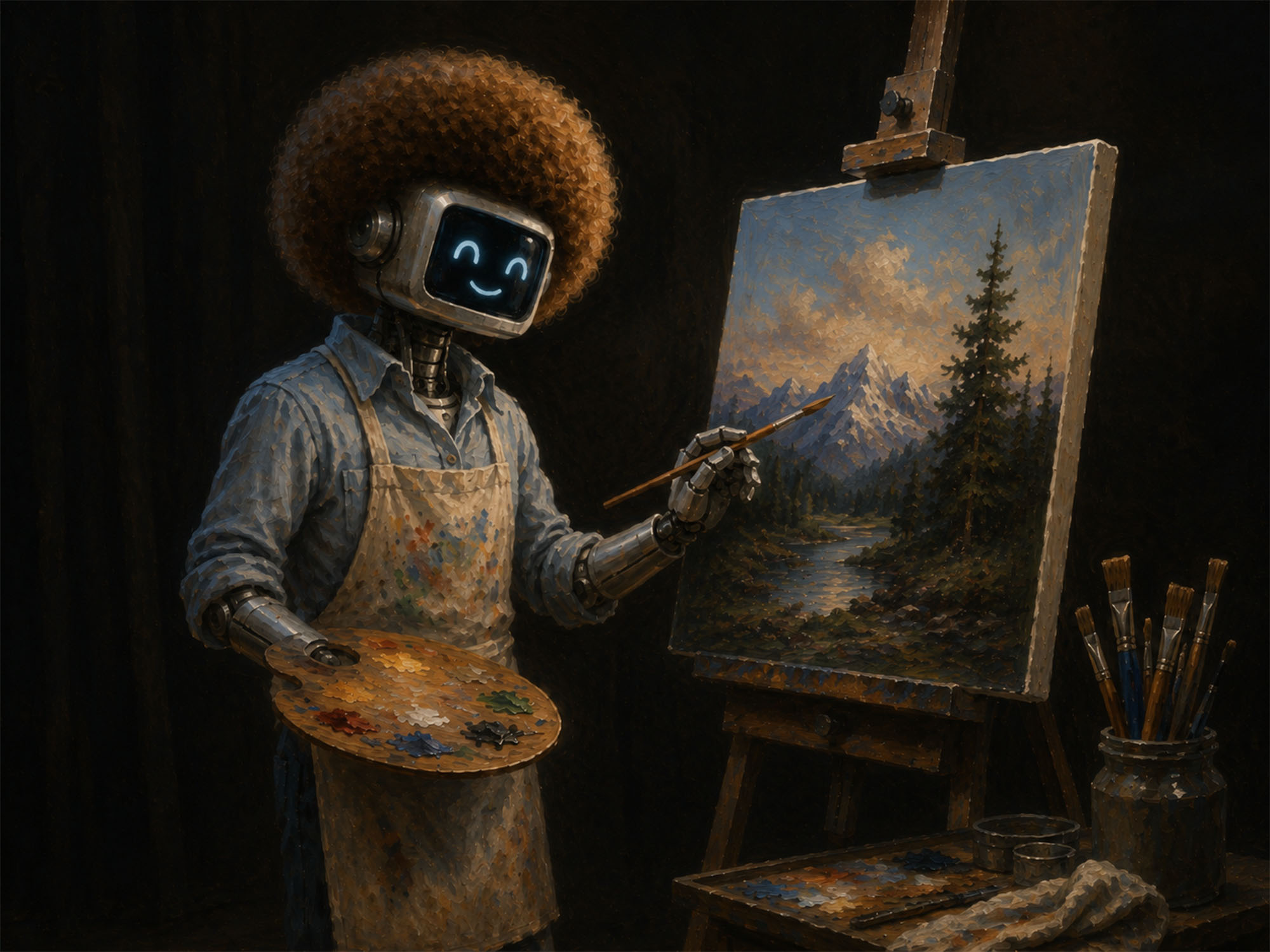
When Lewis Carroll wrote *Alice in Wonderland*, he was not trying to trick you into believing that somewhere in England, a talking cat was dispensing Zen-like wisdom to passersby.
The Cheshire Cat was a vehicle for the wisdom.
When the love of your life cheated on you during your sophomore year of college and said, “They’re just a friend,” they were trying to get you to distrust what you were seeing with your own eyes.
That is the line.
When we create with AI, we never attempt to get people to distrust their own eyes when trusting their eyes is the difference between success and failure, harm and safety, gain and loss.
That’s super bad karma.
Make all the Cheshire Cats you want.
Just don’t gaslight anyone with them.
2. AI does not rescue bad taste. It amplifies it.
Alice: “Would you tell me, please, which way I ought to go from here?”
The Cheshire Cat: “That depends a good deal on where you want to get to.”
Alice: “I don’t much care where.”
The Cheshire Cat: “Then it doesn’t much matter which way you go.”
Have a vision.
If you don’t know what you want, AI will not save you. It will simply help you create a very polished version of not knowing what you want, and everyone will be able to smell it but you.
That is where AI gets dangerous for creatives.
It can make mediocre ideas look finished. It can make bad taste look expensive. It can give you fifty options so quickly that you mistake abundance for direction.
If you don’t have vision or taste, hire someone who does.
Ask yourself:
What do I really want?
3. When humanity is the product, use humans.
By definition, you cannot fake authenticity.
Authenticity is not a filter. It is not a visual style. It is not grain, blur, bad lighting, or a simulated disposable camera look.
Authenticity is the residue of something real having happened, for better or for worse.
There are times when the fact that a messy, imperfect, amateur human being made the thing is the whole point.
In those moments, use humans.
Hire a photographer. Photograph the real human. The flaws might be the proof.
4. Sometimes fake is fine.
Sometimes fake is the whole point.
The existence of Pixar.
I rest my case.
Nobody cares whether the fake rat, fake cowboy, fake fish, or fake cat was created with a pencil, a render farm, or a machine hallucinating elegantly in a server room somewhere.
The question is whether the fake thing helps tell a true story.
Need a beautiful image of rolling cornfields at dusk for a creative piece?
Fine.
If you are not claiming it is a specific real place, and nobody’s trust depends on that location being real, AI may be a perfectly good tool.
Need a picture of John Travolta for your new male enhancement formula?
As much as I want to encourage this behavior, don’t.
Ask yourself:
What part of this is allowed to be fake?
What part needs to be human for it to have credibility?
That is the whole game.